
Getting a loan in Ireland is not about proving income but about qualifying for the detailed affordability assessment. Most loan providers operating legally in the country conduct checks to ensure that the borrower can repay the dues, given the financial circumstances.
It reduces the chances of default for the borrower as well. However, only a few pass the checks to get a loan. Thus, the guide explains the affordability checks and how one can pass them to get the loan. If you are applying for the first time, then you may benefit from this.
What do you mean by loan affordability tests?
When you apply for personal loans in Ireland, you basically need to pass the affordability test. It is a process in which the loan provider checks your credit score, income, repayment ability, past debts and current monthly liabilities to determine the amount you can borrow comfortably. All these aspects help determine the total monthly expenses, income and the space for the additional loan.
It is a part of a responsible loan providing structure that protects the interests of the creditor and the borrower. As a part of confirming the affordability, the loan provider demands proofs like bank statements, salary proof, credit card statements, tax statements, etc.
All this helps you borrow responsibly and make sure that you can afford the loan alongside other major monthly expenses. However, if you fail the test, you may not get the loan.
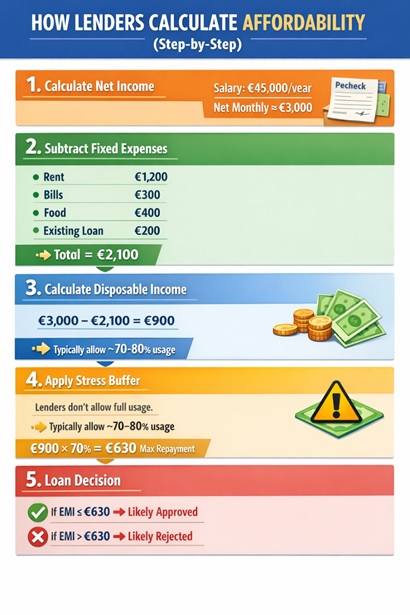
Which 3 major pillars determine the loan affordability?
Every loan provider has unique aspects that help them define their affordability test structure. Precisely, all of it is based on 3 major pillars of loan affordability:
a) Income
Income is the critical requirement to qualify for any loan. Here, most loan providers check:
- Employment history
- Current income (minimum 3 months of current income proof)
- Income consistency
- Employment type (full-time- preferable)
Basic requirement: pay-slips +bank statements, consistent employment.
b) Debt-to-income ratio
It is a ratio of total debts to total monthly income. Most individuals earning a decent living must have a 30:70 as an ideal ratio. If your debts exceed your income, you have a high debt-to-income ratio, which may affect the loan approval.
According to the fact, the total monthly expenses should not exceed 30-40% of your monthly income. For example, if you earn €3000 monthly, your monthly repayments must not exceed €1,050–€1,200.
| Passed the test | Failed the test |
| Income: €3,500/month | Income: €3,000 |
| Expenses: €2,200 | Expenses: €2,400 |
| Available: €1,300 | Available: €600 |
| Loan EMI: €400 (approved) | Loan EMI: €550 (rejected due to risky profile) |
c) Living expenses
It contributes to the things you spend monthly on. It could be:
- Rent
- Groceries
- Car fuel/repair
- Utility bills
- Transport
- Loan payments
5 steps to pass the personal loan affordability test
If you are here to understand the best strategies to qualify for the affordability test, the following tips may help:
1) Reduce the debt count before applying
Counter and pay the high-interest debts first. It reduces the debt-to-income ratio instantly. For example, you can repay credit card debts, payday debts, overdrafts, etc. It also boosts your credit score instantly. Moreover, paying debts helps you fetch more credit utility that you can use for the next loan. Here are other debts that you can pay to improve your debt-to-income ratio:
- Car loans
- Personal loans
- Car finance
However, you must understand a few things before prioritising a debt to pay. It could be the amount you owe, total penalties and interest cost.
2) Check and optimise bank statements
As mentioned above, most loan providers check the bank statements of the past 3-6 months to gauge your loan affordability. Therefore, check whether you have updated records of the same. Most loan companies analyse the payment behaviour of a borrower closely. A major gap between payments, paying part payments or skipping one may directly affect the loan approval.
Therefore, analyse bank statements and make sure that the expenses mentioned are yours only. If you figure out an unrelated expense, contact Credit Registrar for further information. You must have relevant proof of some expenses that you made. It could be rent, car repair, or home renovation.
Also, try to reduce discretionary expenses like buying dresses, dining out, movie nights, etc. It may help you use the money for important reasons like clearing debt. The cleaner the profile, the better interest and terms you may get.
3) Choose the right amount and term
Picking the amount that does not exceed your monthly expenses is the best one. Therefore, you can use a loan calculator to determine the amount that you may actually qualify for. It should be sufficient to meet needs and must not bother your finances. Similarly, choose a comfortable repayment term. You generally get a choice on that. Identify by when you can repay the dues comfortably. Avoid choosing an unnecessarily short or a longer term. If confused, you can take the help of the loan provider.
4) Reveal stable proof of employment
Income, obviously, is the most important part of a personal loan. Thus, make sure to be clear about the earnings and provide accurate proof. Sometimes, you may hesitate to choose the right one if you have multiple income sources. However, always prioritise primary income ( the one that covers 90% of your income).
It could be full-time earnings as a school teacher. Even if you are working as a part-timer, provide income sources from a verified employer or project-based companies. Income from gambling may not qualify as a legal source of income. You can prove your employment with documents like:
- Employment Detailed Summary (EDS) that you get from Revenue
- 3-6 months of recent pay slips
- Employment letter
- Form 11 for self-employed people
- Audited accounts
- Business bank statements
- Social welfare proof
- Rental statements
5) Pre-test yourself
Lastly, when you proceed to apply for a personal loan, pre-test yourself, check your DTI, income proofs and documents that you may need to provide. Check the details on the documents, and there should be no discrepancy in them. You can also create a personal loan application checklist and check it before applying.
Bottom line
Thus, these are some strategies that may help you pass the personal loan affordability test. Basically, you need to reduce your unnecessary expenses, boost your income and compare costs before applying. Identify the basic documentation requirements and arrange them well. Apply for only the loan amount that you can afford to repay with interest.